


Introduction: Businesses Have Data. But Are They Getting the Answers They Need?
Every day, businesses generate data through sales, customer interactions, financial transactions, manufacturing activities, and countless other operations.
But here’s something worth thinking about: having access to data doesn’t necessarily mean having the answers.
A sales report may show what happened last month, but what does it tell us about the next opportunity? An inventory dashboard may show current stock levels, but can it help teams anticipate changing demand? Financial reports may reveal performance, but how easily can decision-makers connect those numbers with what is happening across the business?
The real value of data comes when organizations can move beyond simply collecting information and start using it to understand their business.
This is where AI-powered analytics can play an important role.
The Challenge: Too Much Information, Not Enough Clarity
As businesses grow, their data often becomes spread across different applications, departments, and reporting systems.
Sales teams may maintain customer information, finance teams manage financial records, and operations teams track their own performance indicators. While each dataset may be useful on its own, connecting the bigger picture can be challenging.
Some common challenges include:
- Information spread across disconnected systems.
- Time spent preparing and consolidating reports manually.
- Difficulty identifying patterns across large datasets.
- Limited visibility into performance across departments.
- Delays in finding relevant information when decisions need to be made.
When teams spend too much time gathering and organizing information, they may have less time to explore what it actually means.
The question is not simply how much data a business has, but how effectively it can turn that data into useful understanding.
From Data to Insights: Where AI-Powered Analytics Fits In
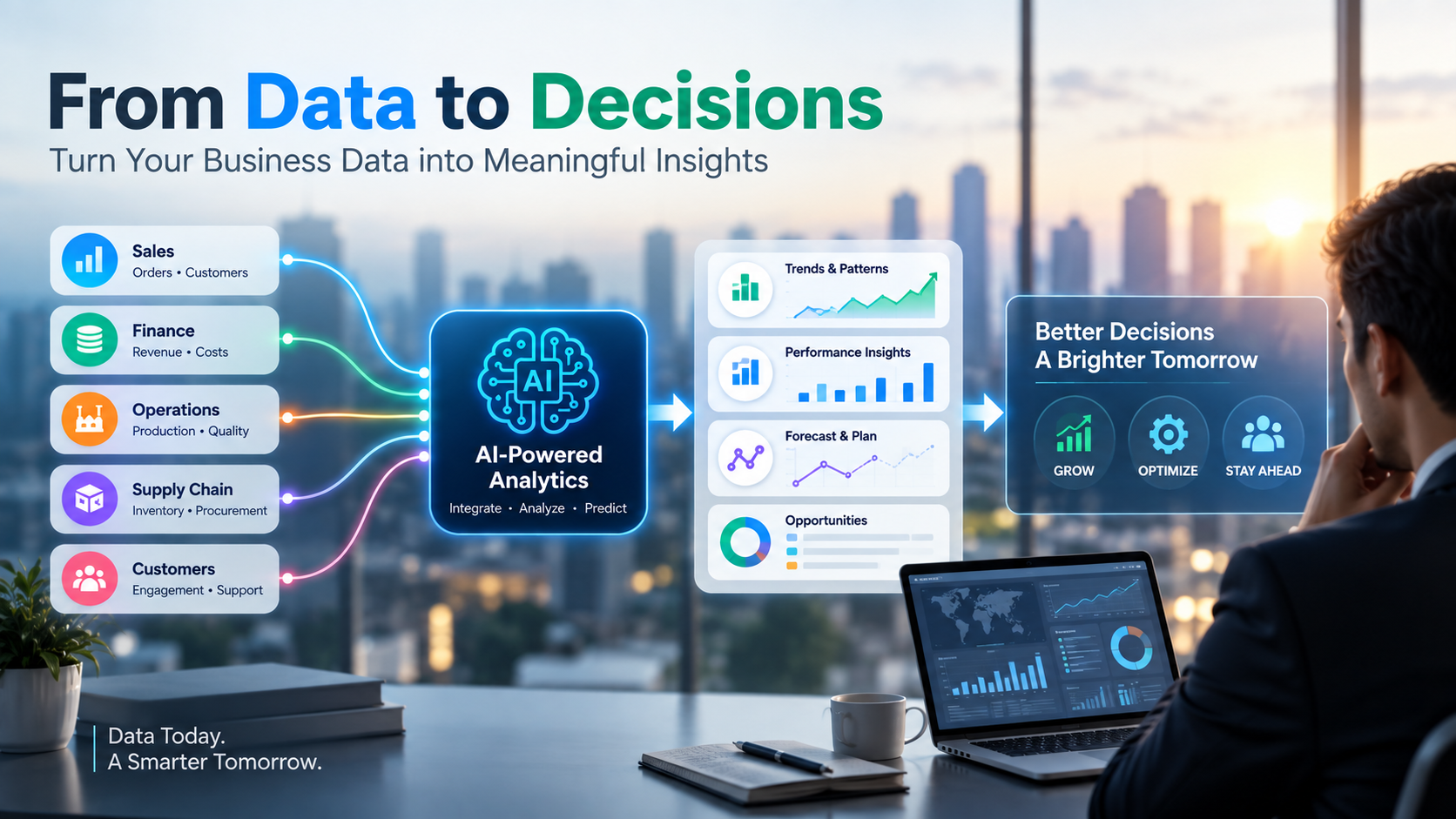
AI-powered analytics brings together data analysis, visualization, and artificial intelligence to help organizations explore their information in different ways.
Rather than relying only on static reports, businesses can use these capabilities to investigate trends, understand performance, and identify questions that deserve a closer look.
1. Bringing Business Data Together
Imagine trying to understand business performance while information is spread across multiple systems.
Connecting relevant data sources can help create a more complete view of business activities. With appropriate integration and data management, teams can access information in a more organized and consistent way.
The aim is to make relevant data easier to find, understand, and use.
2. Making Complex Information Easier to Understand
A spreadsheet containing thousands of rows may hold valuable information, but identifying the important details can take time.
Dashboards and data visualizations can help present key performance indicators, trends, and comparisons in a more accessible format.
With a clearer view of business performance, teams can more easily identify areas that need attention and investigate what may be influencing the results.
3. Using AI to Explore Business Questions
AI-assisted analytics can help users explore datasets, summarize information, and identify potential patterns.
For example, a business team might want to understand why sales figures changed over a particular period or which operational trends deserve further investigation.
AI can help support this exploration, but its outputs still need to be checked against reliable data and business context.
The goal is not to replace business understanding—it is to give teams additional ways to investigate the information available to them.
4. Looking Ahead with Predictive Analytics
Traditional reporting often focuses on what has already happened. Predictive analytics uses historical data and analytical models to estimate what might happen next.
Depending on the available data and the suitability of the models, this can support activities such as demand forecasting, resource planning, and identifying potential operational challenges.
Predictions are not guarantees. Their value depends on the quality of the data, the assumptions behind the models, and how thoughtfully the results are interpreted.
From Insights to Decisions: Putting Data to Work
Insights become more useful when they help answer practical business questions.
Here are a few examples of how analytics can support different enterprise functions.
Manufacturing and Production
Manufacturing operations generate data related to production, equipment, quality, and resource utilization.
Analyzing this information can help teams review production trends, understand operational performance, and identify areas that may need further attention.
When suitable historical data is available, predictive analytics may also support production planning and forecasting.
Sales and Customer Operations
Sales and customer-facing teams work with information such as customer interactions, sales pipelines, and transaction history.
Analytics can help them examine sales trends, understand changes in pipeline activity, and explore customer engagement patterns.
These insights can contribute to more informed sales planning and customer relationship decisions.
Finance and Business Planning
Financial data provides an important view of an organization’s performance.
Analytics can help finance teams examine revenue and expenditure trends, compare actual results with plans, and support budgeting and forecasting.
When financial information is presented clearly, decision-makers can better understand the factors behind business performance.
Supply Chain and Inventory
Inventory and supply chain decisions often depend on understanding stock movement, purchasing activity, and changing demand.
Analytics can help businesses examine these patterns and identify areas for further investigation.
Where reliable data and appropriate models are available, forecasting can also support inventory and supply planning.
Across these functions, the common thread is the same: using information to understand what is happening, explore why it may be happening, and make more informed decisions about what to do next.
How Quocent Supports Data-Driven Transformation
At Quocent, our AI & Data Analytics services align with the growing need for businesses to make meaningful use of their data. We help organizations explore how data analytics, visualization, and AI capabilities can support better visibility, meaningful insights, and informed business decisions.
Explore Quocent’s AI & Data Analytics services to learn more about our capabilities: https://quocent.com/our-
We recognize that the value of analytics goes beyond presenting numbers on a dashboard. It is about helping organizations explore their information, understand relevant patterns, and connect insights with business objectives.
Through AI and data analytics capabilities, businesses can explore opportunities to improve data visibility, support analysis, and make more informed decisions across their operations.
The starting point is understanding the business challenge—and then exploring how data and intelligent technologies can help address it.
Conclusion: The Next Step Is Not Just More Data
Businesses will continue to generate information across their operations. The challenge is making that information useful.
From understanding performance to exploring trends and supporting future planning, AI-powered analytics can help organizations approach business questions with greater visibility and a more informed perspective.
But meaningful progress begins with the right questions, reliable data, appropriate technology, and people who can interpret the insights.
Because the real value of data isn’t in how much we collect—it’s in what we learn from it and how we use that understanding to move forward.
At Quocent, we believe AI & Data Analytics can help businesses take meaningful steps toward more insight-driven operations.